





Synergy Wholesale DDoS Incident
 Ash Tabaei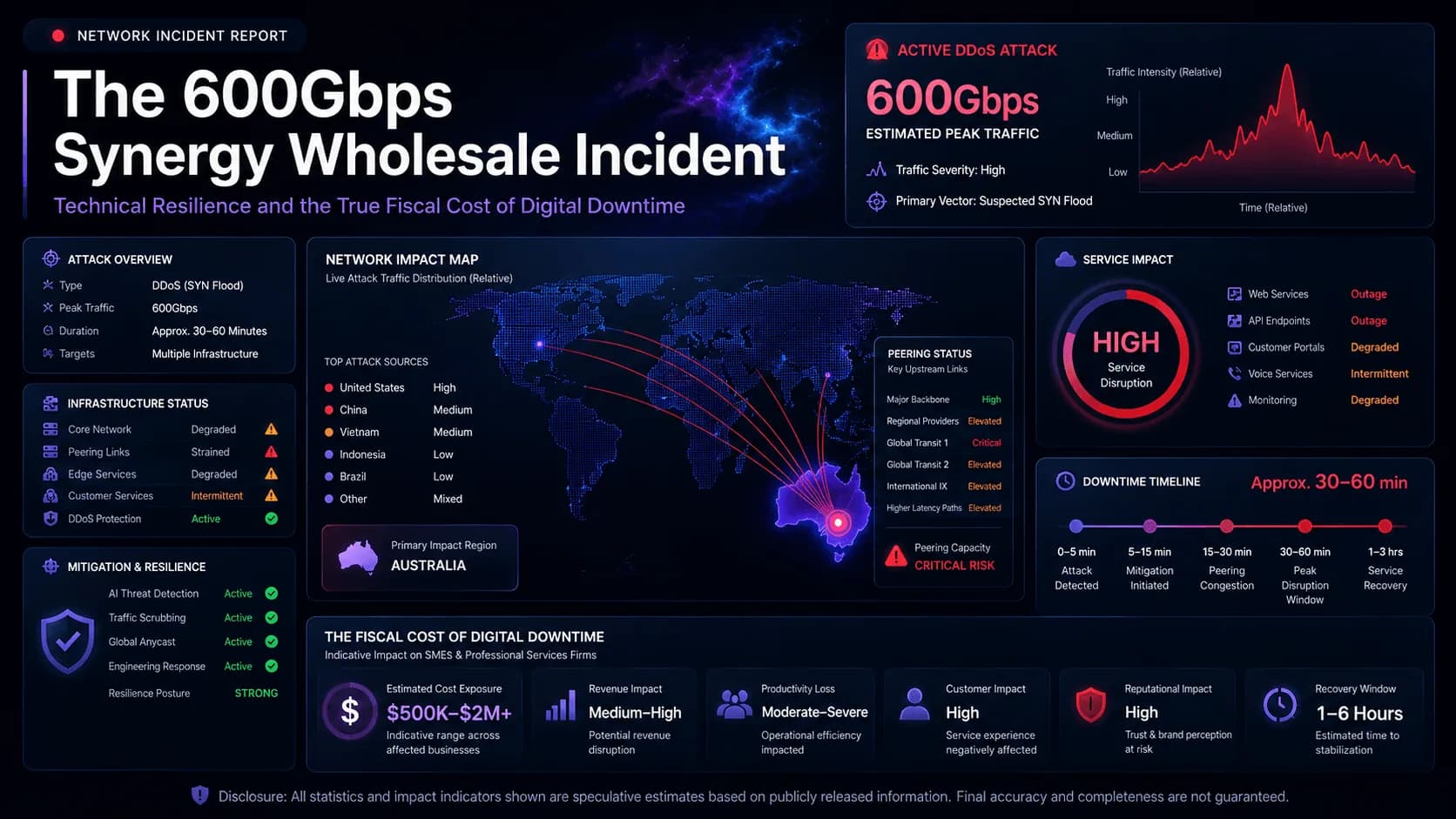
Synergy Wholesale DDoS Incident: Commercial & Technical Lessons
The 600Gbps Synergy Wholesale Incident: Technical Resilience and the True Fiscal Cost of Digital Downtime
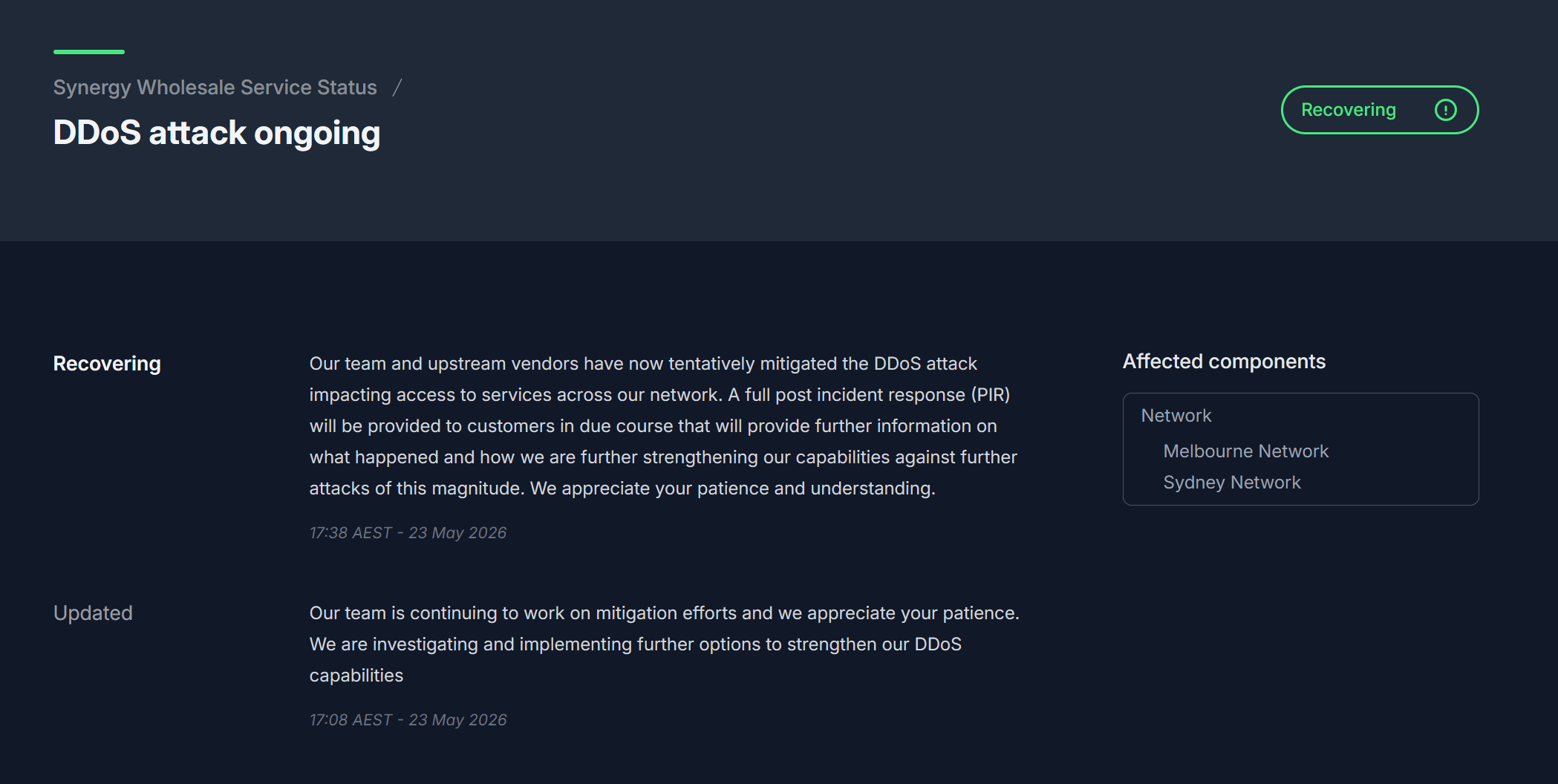
Over the weekend, a coordinated Distributed Denial of Service (DDoS) attack targeted Synergy Wholesale, Business Nebula’s primary Australian infrastructure partner. The volumetric attack peaked at an unprecedented scale estimated to be in excess of 600Gbps.
The sheer magnitude of the traffic saturated local data-peering networks, briefly forcing two major national telecommunications transit providers completely offline and causing a partial or complete loss of service for un-cached endpoints.
For business leaders managing small-to-medium enterprises (SMEs) and professional service firms, this incident serves as a critical, real-world case study of how macro network vulnerabilities can have serious commercial consequences if multi-layered redundancies are not present.
Systemic Volumetric Risks and Provider Response
Volumetric DDoS attacks present an escalating challenge across digital infrastructure pipelines. The Australian Signals Directorate (ASD), in its threat intelligence reporting, notes a major surge in national Denial of Service (DoS/DDoS) disruptions, with volumetric events frequently impacting digital supply chains at the hardware carrier level.
Synergy Wholesale addressed this 600Gbps saturation professionally, maintaining communications with operators and implementing carrier-level traffic routing within a reasonable timeframe.
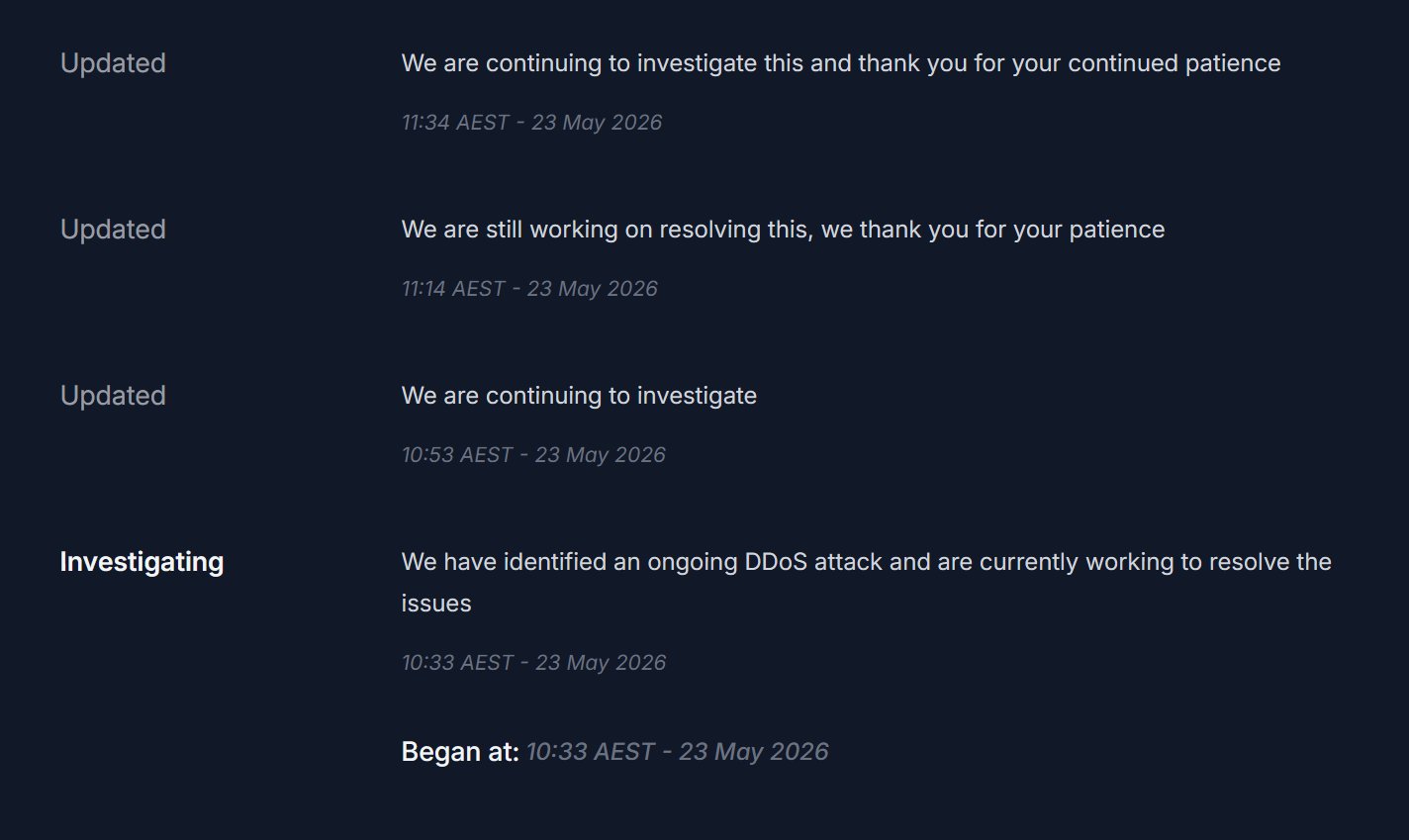
Their executive team summarized the event directly in their post-mortem:
“We were the second major Australian digital service provider to be specifically targeted by the same group over the past two weeks, who have proven to have the ability to launch distributed denial-of-service (DDoS) attacks against network operators that completely overwhelm conventional mitigation methods… In eighteen years, we have never seen an attack of this size or scale.”
From our perspective, while detailed root-cause reporting is the expected benchmark for mature SaaS environments and enterprise networks alike, Synergy’s professional handling over the weekend, combined with their current engagements to systematically scale permanent edge defenses, reflects sound operational governance.
Anatomy of the Impact: The Architecture Variable
Because Business Nebula deploys automated real-time uptime monitoring across our entire managed client portfolio, our team was notified of the network degradation immediately at 10:30 AM AEST on Saturday. This baseline data visibility allowed our engineers to evaluate endpoints, isolate risks, and maintain clear communications with our clients.
The real-world operational impact of this 4-to-6-hour window was directly determined by a single variable: System Architecture Redundancy.
For static, brochure-style websites that do not actively capture customer intent, a temporary window of invisibility carries minor commercial consequence. However, the higher impact is felt heavily by established service firms and B2B consultancies who actively leverage their digital presence for commercial benefit, relying on it to capture pipeline, sustain client portals, and process inbound capital. The outcome for these firms varied sharply based on their configurations:
- Standard Configurations: Sites processing traffic directly through un-cached web servers experienced a complete infrastructure freeze during the transit blockade. Fortunately, because this incident was exclusively a volumetric denial-of-service block and not an infiltration vector, zero corporate databases were compromised, and no data loss occurred.
- Redundant Configurations: Clients utilizing premium multi-layered architectures, split-DNS routing, and Cloudflare Content Delivery Networks (CDNs) experienced highly mitigated commercial impacts. Because their static layouts, CSS structures, and core scripts were cached globally across Cloudflare’s distributed edge network, their storefronts remained fully responsive to end users outside the congested local data links.
A 6-Hour Fiscal Impact Model
When a website is tied to active lead generation, downtime is not just a technical inconvenience. It creates direct commercial exposure across paid media, inbound enquiry flow, and buyer trust.
As an illustrative model, consider a mid-market professional services firm running a Google Ads campaign during a 6-hour outage:
| Variable | Baseline Assumption |
|---|---|
| Paid search traffic | 15 clicks per hour |
| Cost per click | $8.00 |
| Landing page conversion rate | 8% |
| Indicative pipeline value per qualified lead | $2,000 |
| Outage duration | 6 hours |
On those assumptions, the immediate paid media exposure is:
6 × 15 × $8.00 = $720
That represents $720 in at-risk media spend, assuming campaigns continued serving while the destination website or landing page was unavailable.
The larger exposure is the lost opportunity to convert high-intent traffic:
6 × 15 = 90 compromised visitors
90 × 8% = 7.2 potential inbound leads
7.2 × $2,000 = $14,400
On this model, a 6-hour outage creates approximately $15,120 in combined paid media exposure and unrealised pipeline opportunity.
This should not be read as guaranteed revenue loss. It is a commercial sensitivity model based on assumed traffic, conversion, and lead-value inputs. It also excludes organic visitors, direct traffic, referral traffic, branded search demand, and returning users. For firms with strong SEO visibility or high-intent service pages, the total commercial impact may be materially higher, even where there is no direct click cost attached to those visitors.
This is where operational controls matter. For Business Nebula managed PPC accounts, uptime monitoring helped mitigate exposure by allowing paid campaigns to be paused or controlled once availability issues were detected. The broader outage could not be eliminated, but the risk of continuing to send paid traffic into unavailable website destinations was reduced.
For businesses investing in search acquisition, this reinforces the need to pair paid media with uptime monitoring, conversion tracking, and responsive campaign governance. See Business Nebula’s managed ads service for more on PPC campaign management and acquisition infrastructure.
Escalating the Risk Profile: Volume vs. Infiltration
While a volumetric DDoS attack presents a severe, quantifiable constraint on active pipeline generation, it remains a relatively low-consequence cyber event because it does not compromise system integrity.
SMEs must recognize that while this weekend’s event resulted merely in temporary downtime, the broader cybersecurity landscape features far more aggressive attack vectors carrying exponentially greater commercial liability, as frequently highlighted by the Australian Cyber Security Centre (ACSC):
- Malicious Database Injections: SQL or cross-site scripting (XSS) injections can completely corrupt relational schemas, destroying years of accumulated custom data structures, client case files, and relational content management architectures.
- Malicious File Takeovers: Ransomware or hidden core administrative overrides can lock an enterprise completely out of its own web infrastructure, weaponizing corporate domains to serve malware or phishing payloads to the general public.
- Customer Data Exfiltration: Breaches targeting client data repositories subject an enterprise to severe regulatory compliance penalties, catastrophic reputational erosion, and direct litigation under Australian privacy frameworks.
While a temporary infrastructure freeze carries a fixed operational cost, a structural database breach or data loss can completely destabilize an enterprise’s balance sheet.
Engineering the Shield: A Pragmatic Defensive Checklist
To insulate your business asset against both volumetric noise and structural vulnerability, senior leadership must move past basic hosting setups and enforce a disciplined, multi-layered engineering framework:
- Enterprise Edge Routing: Implement advanced, tiered CDN proxy layers before traffic ever communicates with your primary server. This acts as an un-saturable shield, absorbing and filtering volumetric spikes at the global network edge.
- Decoupled Intake Architectures: Ensure that mission-critical operational tools, such as web lead forms, client scheduling calendars, and onboarding workflows, are routed through asynchronous, externally backed databases, guaranteeing that pipeline intake persists even if a primary hosting tier is temporarily frozen.
- Clinical Code and Security Hardening: Engage in a comprehensive WordPress Structural Audit and maintain rigorous weekly Website Support & Maintenance Plans to keep the WordPress core, database schemas, and localized security firewalls continuously patched. This prevents your server assets from being compromised.
- Isolated Cryptographic Backups: Enforce daily, automated file and database backups stored on completely isolated cloud architecture separate from your hosting network. If a server experiences an unrecoverable hardware or software compromise, your digital asset can be redeployed cleanly within hours.
Network friction across the digital supply chain is an inevitable variable of modern commerce. The enterprises that maintain continuity are those that treat infrastructure not as an afterthought, but as a core layer of risk management.
Is your enterprise digital pipeline insulated against market volatility?
If recent national infrastructure tension has highlighted single points of failure in your technology stack, let’s engineer a defensible, highly optimized framework.
Review your architecture and server resilience strategy with Business Nebula.